It is designed to answer to the following questions:.
- What is the effect on the product properties is I change the polymer type / concentration / molecular weight ?
- Will it stick (to the hand, to another product, ...) ?
- Will it spread easily ?
- Will it keep its shape ?
- Will it be stable ?
- Will it flow ?
- And many more...
Contact us with your problematic and we will determine the right parameters for you!
Automatic and one-click plot of microrheological parameters of the material : elasticity, viscosity, solid-liquid balance...
Automatic plot of particle Mean Square Displacement (MSD) or decorrelation curve (d2) for experts in DWS.
APPLICATION FIELDS
- Cosmetic
- Pharmaceutical
- Food
- Paint & Ink
- Polymers
- Oil & Petroleum
- & many others...
A NEW WAY TO ANALYSE VISCO-ELASTIC PRODUCTS 3 KEY PARAMETERS
3 key parameters
Based directly on the MSD curves (Mean Square Displacement), 3 parameters are directly computed in just one-click without any parameters for the user to define.
These parameters are kinetic, meaning the user can monitor the evolution of any product (gelation process, structure recovery after a stres, long term stability, etc...) versus ageing time.
SOLID-LIQUID BALANCE (SLB)
Monitor properties such as: adhesion, spreadability, gel point, shape stability, physical stability, etc...
Using this parameter allows the user to know easily if his product is rather liquid-like or solid-like (how is the gel structure?).
- SLB = 0, product is solid ;
- 0 < SLB < 0.5, product is more solid than liquid ;
- 0.5 < SLB < 1, product is more liquid than solid ;
- SLB = 1, product is purely liquid (newtonian) ;
SLB of a polymer system during a change of temperature
ELASTICITY INDEX (EI)
Monitor properties such as: mesh size, hardness, recovery after a shear, etc...
This parameter enables easy comparison of many products in terms of elasticity strength. This value offers a quick and easy ranking of the structure in any studied products, in just one-click.
EI of two different gelatins during cooling of the system
MACROSCOPIC VISCOSITY INDEX (MVI)
Monitor properties such as: effect of a thickening agent, texture, flowability, long-term stability, etc...
Rank your products depending on their macroscopic viscosity at zero-shear in just one-click, and control their stability by monitoring the evolution of this parameter versus ageing time.
MVI of three emulsions stabilised by different thickeners
PHYSICAL PARAMETERS
For the experts in rheology and DWS, it is possible to compute physical parameters such as the elastic and viscous moduli (G' and G''), relaxation time (tR), macroscopic viscosity at zero-shear, diffusion coefficent, mesh size, and many others...
microrheology MAIN ADVANTAGES
- One-click experiment & results (no parameters needed).
- Measurement AT REST.
- Non-intrusive measurement.
- Ageing analysis on the very same sample.
EASY OPERATION
EASY SAMPLING
Material is sampled in a disposable glass cell:
- Easy to handle
- No evaporation
- Easy storage
- Easy to clean
EASY SAMPLE PROCESSING
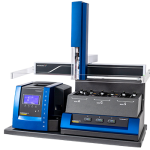
- The Sample is loaded in one of the 6 storage positions:
- One click measurement
- No apparatus set up
EASY DATA PROCESSING
- One-click automatic plot of:
- Particle Mean Square Displacement (MSD)
- Solid Liquid Balance (SLB)
- Elasticity Index (EI)
- Macroscopic Viscosity Index (MVI)
- Physical parameters (such as G' & G'' µR versus frequencies, relaxation time tR, macroscopic viscosity...)
All frequencies are available from MSD data
- Up to 5 decades
- No torque effect
- No slipping effect
- No motor inertia
- No geometry configuration
- No need to determine the linear visco-elastic region (LVER)


















-150x150w.jpg)